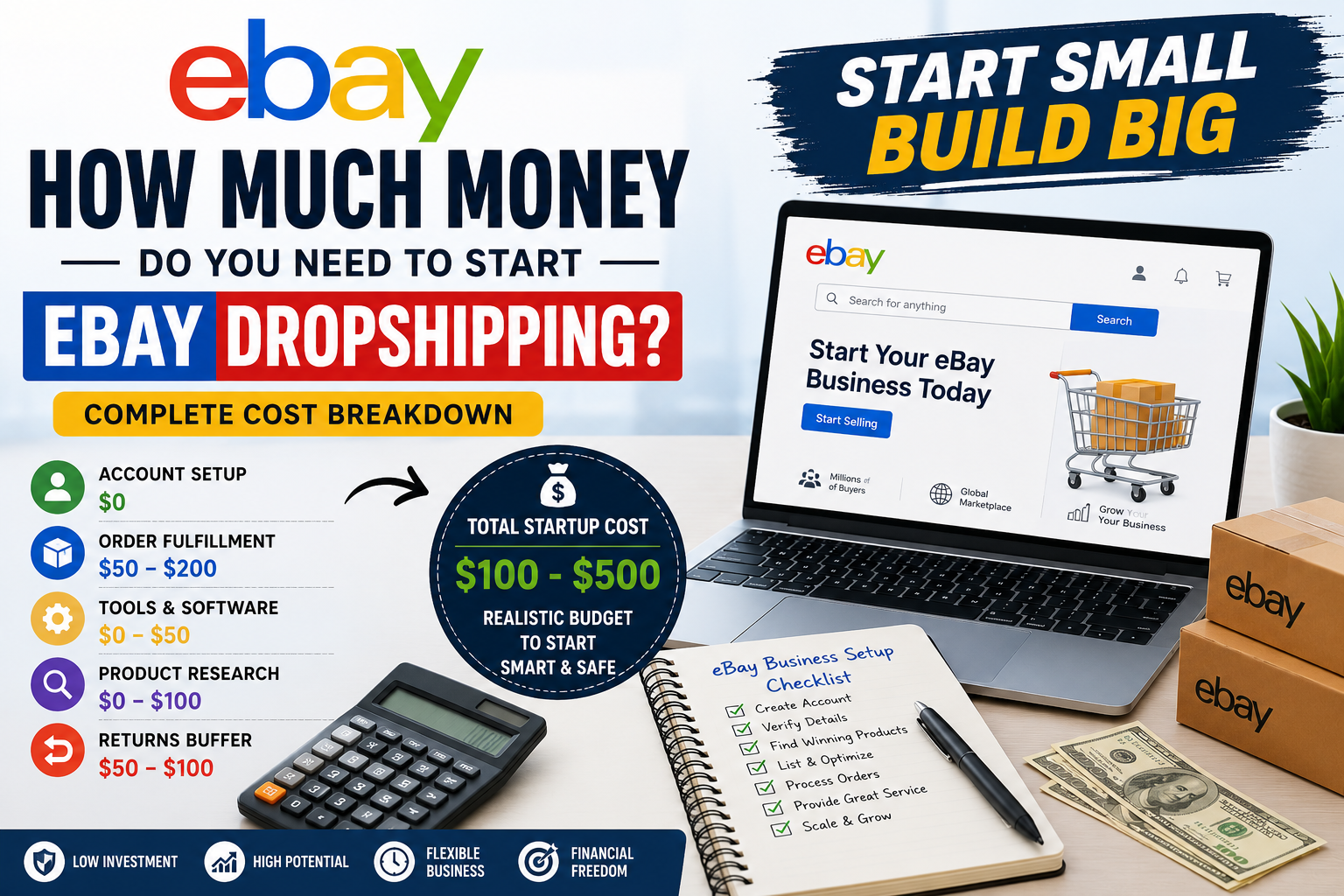
One of the first questions every beginner asks is simple: how much money do I actually need to start eBay dropshipping?
You’ve probably seen different answers. Some say you can start with zero. Others claim you need hundreds or even thousands of dollars.
Here’s the truth — you don’t need a huge budget, but you do need a smart, realistic setup.
What this really means is simple: your startup cost depends on how you plan, not just how much you spend.
In this guide, we’ll break down the real costs, hidden expenses, and what you actually need to start your eBay dropshipping business the right way in 2026.
Can You Start eBay Dropshipping With $0?
Technically, yes — but practically, it’s not ideal.
Here’s why:
eBay often requires you to fulfill orders first before receiving payouts, especially for new accounts. This means you need some initial cash flow to process orders.
Also, running a business without any budget limits your ability to:
- Test products
- Handle returns
- Manage risks
So while $0 is possible in theory, a small starting budget gives you a much smoother and safer start.
Minimum Budget to Start (Realistic Range)
For most beginners, a realistic starting budget is:
$100 to $500
This range allows you to:
- Cover initial orders
- Handle basic tools (if needed)
- Manage small risks
Let’s break down exactly where this money goes.
Complete Cost Breakdown
1. eBay Account Setup (Free)
Creating an eBay account is completely free.
Cost: $0
However, you should:
- Use real information
- Verify your identity
- Set up payment methods properly
A clean setup prevents issues later.
2. Product Sourcing Cost
Since dropshipping doesn’t require inventory, you don’t pay upfront for stock.
But you do need money to fulfill orders before receiving payment.
Example:
- You sell a product for $50
- Your supplier price is $35
- You need $35 upfront to process the order
Recommended starting buffer:
$50 – $200
This depends on how many orders you expect initially.
3. eBay Fees
eBay charges fees on each sale.
Typical fees:
- Final value fee (around 10%–15%)
- Payment processing fee
Example:
If you sell a product for $50:
- Fees might be around $6–$8
These are deducted from your sale, not paid upfront.
4. Tools and Software (Optional)
You can start without tools, but some tools make things easier.
Common tools:
- Product research tools
- Listing automation tools
- Price tracking tools
Cost range:
$0 – $50/month
Beginners can start manually and upgrade later.
5. Product Research Investment
This is not always a direct cost, but it’s critical.
If you don’t invest time (or money) in research, you risk choosing bad products.
Options:
- Free research (manual)
- Paid tools or expert help
Budget: $0 – $100
6. Returns & Refund Buffer
Returns are part of eCommerce.
You should keep a small buffer to handle:
- Refunds
- Damaged items
- Customer issues
Recommended buffer: $50 – $100
This protects your account and reputation.
7. Internet & Basic Setup
You likely already have this, but it’s part of your setup.
Includes:
- Laptop or PC
- Internet connection
Cost:
Already covered in most cases
Total Startup Cost Summary
Here’s a realistic breakdown:
| Expense | Estimated Cost |
|---|---|
| eBay Account | $0 |
| Order Fulfillment Buffer | $50 – $200 |
| Tools (Optional) | $0 – $50 |
| Product Research | $0 – $100 |
| Returns Buffer | $50 – $100 |
Total Recommended Budget:
$100 – $500
This gives you enough flexibility to start safely and grow.
Low Budget vs High Budget Approach
Starting With Low Budget ($100–$200)
You will need to:
- Start with fewer listings
- Test slowly
- Focus on one market
- Manage everything manually
This is slower but still works.
Starting With Higher Budget ($300–$500)
You can:
- Test more products
- Scale faster
- Use tools
- Handle multiple orders easily
This reduces risk and increases growth speed.
Hidden Costs Beginners Ignore
Many new sellers don’t think about these:
1. Slow Payments
New eBay accounts may have delayed payouts.
This means:
You need enough cash to keep fulfilling orders.
2. Price Changes
Supplier prices can change.
If you don’t monitor this, your profit can disappear.
3. Returns
Unexpected returns can impact your cash flow.
4. Time Investment
Even if money is low, time investment is high.
You need to:
- Research
- Optimize listings
- Manage orders
How to Start With a Small Budget (Smart Strategy)
If your budget is limited, follow this approach:
1. Start With 5–10 Products
Focus on quality, not quantity.
2. Choose Low-Risk Products
Avoid expensive items at the beginning.
3. Use Manual Research
Save money by doing your own research.
4. Reinvest Profits
Use your first earnings to scale.
5. Focus on One Market
Don’t spread yourself too thin.
How Much Can You Make?
Your earnings depend on:
- Product selection
- Pricing strategy
- Optimization
- Consistency
Some beginners make:
- $100–$500/month initially
With scaling:
- $1,000–$10,000+/month is possible
But it takes time, testing, and improvement.
Is It Worth Starting in 2026?
Yes — but only if you approach it seriously.
eBay dropshipping still works because:
- There is consistent demand
- Entry cost is low
- Global markets are growing
But competition is smarter now.
You need strategy, not just effort.
Final Thoughts
Starting an eBay dropshipping business doesn’t require a huge investment.
But it does require:
Smart planning
Proper setup
Consistent effort
What this really means is simple:
You don’t need a lot of money to start — you need the right approach.
Want to Start Without Guesswork?
If you want to build your eBay dropshipping business with a clear strategy and avoid common mistakes, we can help you set everything up properly.
Let’s create a store that’s ready to generate sales from day one.