
How Does eBay Bidding Work? A Simple Breakdown
You click “place bid,” someone else swoops in at the last second, and suddenly you’ve lost an item you were sure was yours. If that’s happened to you, you’re not alone eBay’s bidding system trips up more people than you’d think, mostly because it’s not as simple as “highest number wins.” Millions of auctions close on eBay every single day, and a good chunk of buyers walk away confused about why the price jumped, why they got outbid without warning, or why a listing didn’t sell despite having the top bid.
In this guide, you’ll learn exactly how does eBay bidding work, from the moment you enter a bid to the final seconds of an auction. We’ll cover proxy bidding, sniping, reserve prices, and what to do if you get outbid in the last ten seconds.
Quick Answer: eBay bidding uses a system called proxy bidding. You enter the maximum amount you’re willing to pay, and eBay automatically bids on your behalf in small increments only as much as needed to keep you in the lead, up to your max. The auction ends at a fixed time, and whoever has the highest bid when the clock hits zero wins the item.
What Exactly Is Proxy Bidding?
Proxy bidding means eBay bids for you, using an amount you set in advance. You never actually see other people’s maximum bids only the current winning price, which rises just enough to beat the next-highest bidder.
Here’s a simple example. Say a vintage camera is listed with a $10 starting bid, and you set your maximum at $50. If someone else bids $15, eBay’s system automatically raises your bid to $20 (just above theirs) not all the way to your $50 limit. Your true maximum stays hidden the entire time, which is exactly the point: it keeps other bidders guessing instead of just matching your number.
How Bid Increments Work
eBay doesn’t let bids climb by $1 at a time once prices get higher it uses a sliding scale.
- Under $1: increments of $0.05
- $1–$4.99: $0.25
- $5–$24.99: $0.50
- $25–$99.99: $1.00
- $100–$249.99: $2.50
- $250–$499.99: $5.00
- $500 and up: increments continue scaling with price
So a $300 auction won’t move in one-dollar steps it jumps by five. Knowing this helps you understand why the displayed price sometimes leaps more than expected after a new bid comes in.
Why Did I Get Outbid Automatically?
This happens because someone else’s proxy maximum is higher than yours, even if you never saw them “actively” bidding. eBay’s system compares max bids in the background and updates the displayed price the moment a higher one is entered.
I’ve seen this trip up first-time bidders constantly you bid $40, see yourself in the lead, then five minutes later you’re outbid with no notification of who did it or when. It’s not personal, and it’s not a glitch. It’s just two proxy maximums quietly duking it out in the background.
What Is Sniping, and Should You Do It?
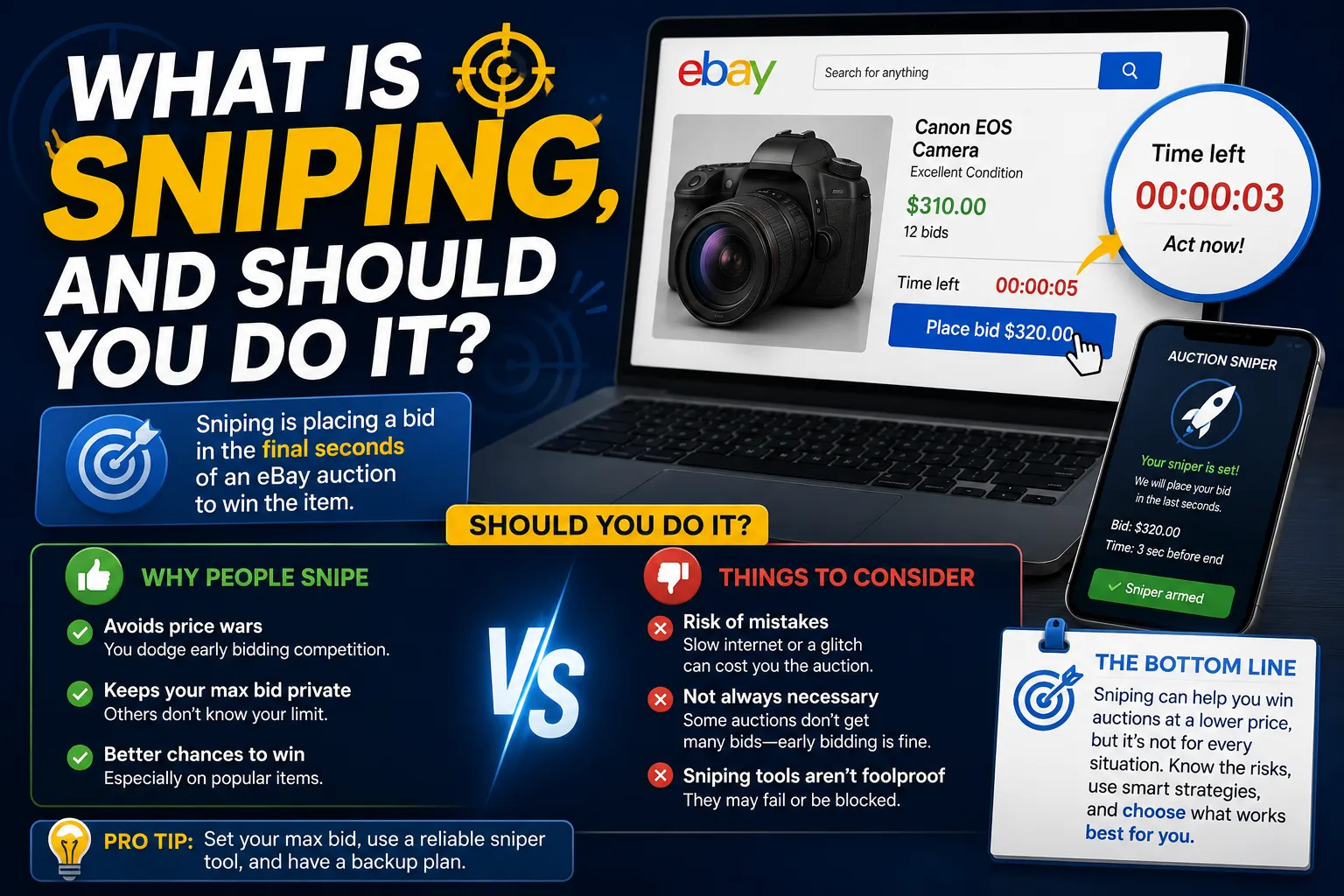
Sniping means placing your bid in the final seconds of an auction, leaving other bidders no time to respond. It’s a well-known strategy on eBay, and honestly, it works because of how eBay auctions end at a hard deadline, not with extended time like some other platforms.
Some sellers hate it, some buyers swear by it, but here’s my take: sniping is really just an efficiency play, not a dirty trick. You’re still bound by proxy bidding rules you can’t bid an unreasonably low amount and expect to win. If you snipe with a $45 max against someone else’s hidden $60 max, you still lose. Sniping just prevents a bidding war from inflating the price through emotional back-and-forth.
Steps to Bid Strategically
- Research the item’s typical selling price (check “Sold” listings)
- Decide your true maximum before the auction nears its end
- Wait until the final 1–2 minutes to place your bid
- Enter your full maximum in one shot don’t bid incrementally
- Refresh the page to confirm you’re the winning bidder once time expires
What’s a Reserve Price and Why Didn’t My Bid Win?
A reserve price is a hidden minimum a seller sets if bids don’t reach it, the item doesn’t sell, even if you’re the highest bidder. eBay listings with a reserve show “Reserve not met” until bidding crosses that invisible line.
This confuses a lot of new buyers who assume the highest bid always wins outright. Not true if a seller sets a $200 reserve on a guitar and bidding only reaches $150, nobody wins, and the seller isn’t obligated to sell. It protects sellers from letting valuable items go too cheap.
Can You Retract or Cancel a Bid?
Yes, but only under specific, limited circumstances. eBay allows bid retraction if:
- The seller significantly changed the item’s description after you bid
- You made a genuine typo (like $500 instead of $50)
- You can’t reach the seller to clarify a listing detail
Outside of these situations, eBay treats bids as binding commitments you’re expected to honor a win. Buyer’s remorse alone won’t get a bid cancelled, so double-check your numbers before hitting confirm.
Retracting a bid also isn’t instant or automatic. You have to go through eBay’s official retraction request process on the item page, and the option typically disappears once an auction is within its final 12 hours. That window exists so buyers can’t yank bids right before the deadline just because someone else outbid them it’s meant for genuine errors, not cold feet.
Auction-Style vs. Buy It Now vs. Best Offer
Not every eBay listing works the same way, and mixing these up is one of the most common sources of confusion for new buyers. Here’s the quick breakdown of the three formats you’ll run into.
Auction-style listings are the classic bidding format this whole guide is about. There’s a start time, an end time, and a rising price driven by proxy bids. You genuinely don’t know what you’ll pay until the countdown hits zero.
Buy It Now (BIN) listings skip bidding entirely. The seller sets a fixed price, and the first buyer to click purchases the item instantly no competition, no waiting. Some listings blend both: an auction with a Buy It Now option that disappears the moment someone places a bid.
Best Offer lets buyers propose their own price to the seller, who can accept, decline, or counter it. It’s more like a negotiation than a bid there’s no countdown clock and no competing bidders driving the price up in real time.
If you want certainty and speed, Buy It Now is your friend. If you’re chasing a deal and don’t mind some risk, auction-style bidding (with a smart strategy) is usually where the bargains live.
Does eBay Extend Auctions Like a “Soft Close”?
Standard eBay auctions do not extend automatically they end at the exact time listed, down to the second, which is exactly what makes sniping so effective in the first place. Unlike some other marketplaces that add extra minutes whenever a late bid comes in, eBay sticks to a hard deadline.
The one exception is eBay Live auctions and certain specialty or charity auction formats, which sometimes use a “soft close” that extends the clock briefly if bids land in the final moments. But for the vast majority of everyday listings electronics, collectibles, clothing, car parts, what you see is what you get: a fixed end time with zero grace period.
This matters practically. If your internet lags or the page takes three seconds to load, you could miss the window entirely. Seasoned snipers often use third-party sniping tools or browser extensions that submit the bid automatically at a precise moment, removing human reaction time from the equation entirely.
Common Bidding Mistakes to Avoid
A lot of buyer frustration on eBay traces back to a handful of avoidable mistakes. Here are the ones I see (and have made myself) most often.
- Bidding emotionally instead of setting a hard limit. It’s easy to keep nudging your bid up “just a little more” once you’re invested in winning. Decide your ceiling before the auction starts and stick to it.
- Ignoring shipping costs when calculating your real max. A $40 item with $25 shipping isn’t a $40 item factor total cost in before you bid, not after you win.
- Bidding way too early with your true maximum. Placing your full max bid three days before an auction ends just gives other bidders time to plan around it. There’s no prize for showing your hand early.
- Assuming “Reserve not met” means the item is broken or fake. It just means the current bid hasn’t hit the seller’s hidden minimum, nothing more.
- Forgetting that bids are legally binding. Treat every bid like a signed agreement to buy, because on eBay, that’s essentially what it is.
How Sellers See Bidding Differently
It’s worth understanding the seller’s side too, since it explains some of eBay’s rules. Sellers can set a starting price low to attract attention and interest, then rely on competitive bidding to push the final price up, a common strategy for collectibles and rare items where demand is hard to predict.
Sellers can also cancel bids from buyers with a poor track record, like a history of unpaid items, and in rare cases, end an auction early if the item is no longer available. From the seller’s chair, bidding isn’t just about price, it’s about filtering for buyers who’ll actually follow through on the purchase.
FAQ
Does the highest bidder always win an eBay auction? Not always. If a seller set a reserve price and the highest bid doesn’t meet it, the item won’t sell. Otherwise, yes! the highest proxy bid at the auction’s end deadline wins the listing.
Can other bidders see my maximum bid amount? No. eBay only shows the current winning price, not anyone’s maximum. Your true limit stays private the whole auction, which is core to how proxy bidding protects bidders from overpaying.
What happens in a tie bid on eBay? True ties are rare because of proxy bidding increments, but if two identical bids land at nearly the same moment, the bid placed first (earliest timestamp) typically wins the auction.
Is bid sniping against eBay’s rules? No, sniping is completely allowed on eBay. It’s a common, legal bidding strategy that takes advantage of the fixed auction end time rather than an extended “last bidder wins more time” format.
Can I increase my maximum bid after placing it? Yes, you can raise your maximum bid at any point before the auction ends. You cannot lower it, though, since that could unfairly undercut bidders you’ve already outbid.
What happens if I win an auction but don’t pay? eBay expects payment shortly after the auction ends, usually within a few days. Repeatedly failing to pay for items you’ve won can lead to an unpaid item strike, bidding restrictions, or even account suspension.
The Bottom Line
eBay bidding comes down to one core idea: you’re not bidding a price, you’re bidding a limit, and the system does the rest quietly in the background. Understanding proxy bidding, bid increments, reserve prices, and the difference between auction-style and fixed-price listings turns a confusing last-minute scramble into a strategy you can actually control.
The buyers who consistently win good deals aren’t the ones bidding the most emotionally they’re the ones who did their homework on sold prices, set a firm ceiling, and trusted the process instead of chasing every price bump. That’s really the whole game in a nutshell.
Next time you’re eyeing an auction, will you set your max early and walk away, or wait for that nerve-wracking final-minute snipe? Either way, now you know exactly what’s happening behind the scenes when that bid button turns green.