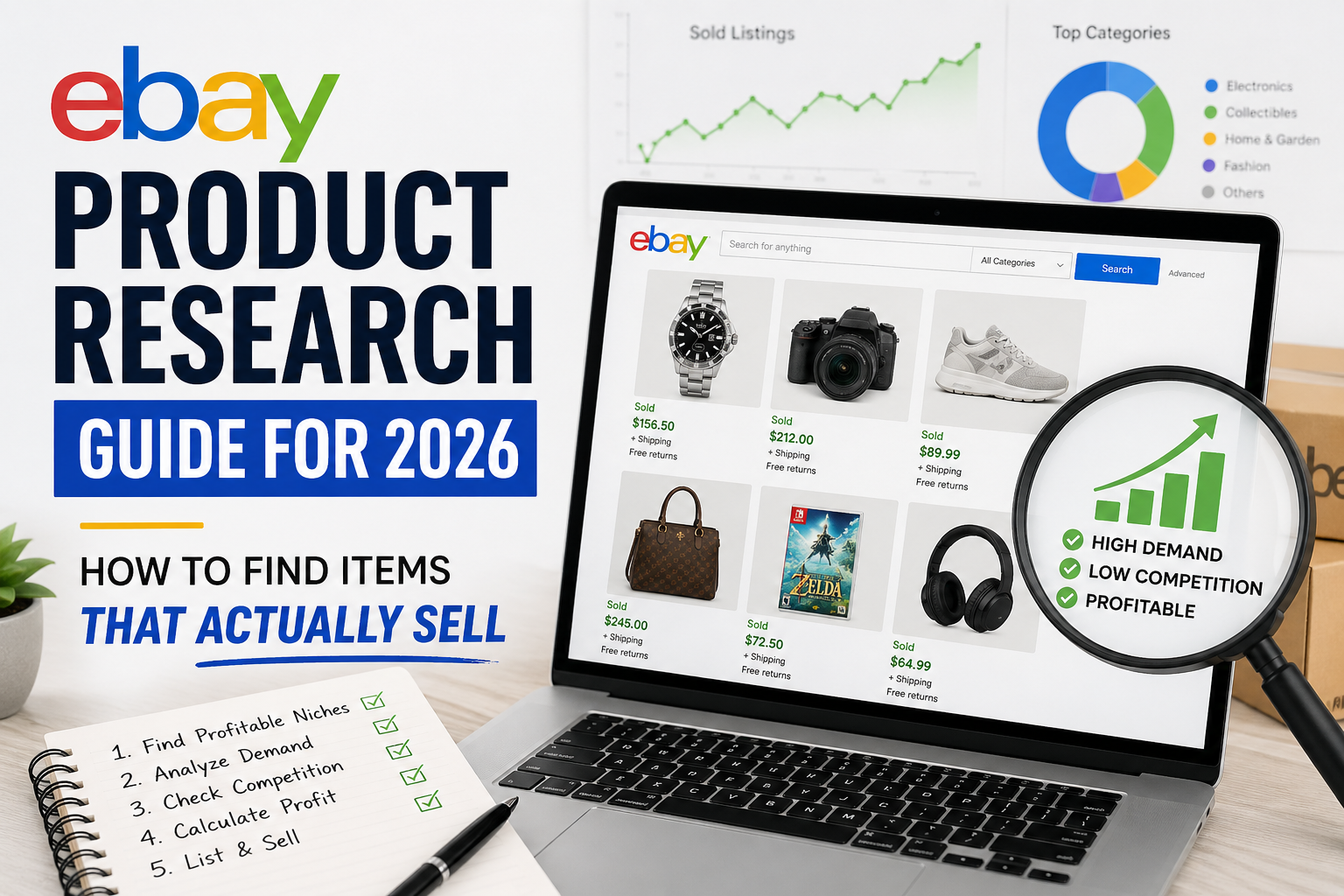
If you’re spending hours listing products on eBay only to watch them sit with zero views and zero bids, you’re not alone. Most new sellers make the same mistake: they pick products based on guesswork, personal preference, or what looks popular — not what the data actually shows.
At eBayExperts, product research is the foundation of everything we do. Before we list a single item, we dig into real market data. Here’s the exact framework we use to find products that sell consistently.
Why Most Sellers Get Product Research Wrong
The biggest misconception in eBay selling is that a “good product” is obvious. In reality, what sells well on Amazon, what’s trending on TikTok, and what looks good in a warehouse are completely different from what converts on eBay.
eBay has its own buyer psychology, its own search algorithm (Cassini), and its own seasonal demand curves. A product that’s a bestseller in one category can completely fail in another. Without understanding the platform’s nuances, sellers burn money on dead inventory and low-margin listings.
Step 1: Start With Sell-Through Rate, Not Views
Most new sellers focus on how many views a listing gets. That’s the wrong metric. What you actually want to know is: out of all the sellers listing this product, how many actually made a sale?
This is called the sell-through rate — and it’s the single most important number in product research.
How to calculate it:
- Search for your product on eBay
- Filter results to show Sold listings (not active)
- Count the sold results in the past 30 days
- Divide that by the total number of active listings for the same product
- Multiply by 100 for a percentage
A sell-through rate above 50% means strong demand with manageable competition. Above 80% is ideal. Below 30%, and you’re entering a crowded market with slow movement.
Step 2: Analyze Completed vs. Active Listings
Here’s a research move most sellers overlook: comparing completed listings (items that ended, whether sold or unsold) against active listings gives you a real picture of how competitive a product category is.
If you see 200 active listings but only 40 sold in the last month, that tells you there are 5x more sellers than buyers. You’d be entering a race to the bottom on price with slim chances of making consistent sales.
What you want to find is the opposite: categories where completed/sold listings significantly outnumber active ones. That’s a demand gap — and demand gaps are where dropshippers make money.
Step 3: Check Average Sale Price Then Look at the Range
The average sale price matters, but the price range matters more.
Why? Because if 90% of a product’s sales happen below $15, your profit margin after eBay fees, PayPal fees, and supplier cost will likely be negative or near zero. You need products that consistently sell in the $25–$150 range, where margins are healthy enough to build a real income.
When reviewing sold listings, look for:
- Price consistency: Products that sell within a tight price band signal stable demand
- Outlier sales: One item selling for $200 in a pool of $20 sales is noise, not a signal
- Trending direction: Are recent sale prices going up, down, or flat? Rising prices indicate growing demand
Step 4: Evaluate Competition Quality, Not Just Quantity
More sellers doesn’t always mean more competition. What matters is the quality of the competition.
When you find a product with decent sell-through rate, click on the top-selling listings and look at:
- Listing quality: Are the photos professional? Is the description detailed and keyword-rich? Or is it a lazy, minimal listing?
- Seller feedback score: Are the top sellers doing 10,000+ transactions a month? Or are they small accounts like where you’d be starting?
- Shipping speed: Are competitors offering fast shipping? Can you match or beat it?
If the top sellers have weak listings, poor photos, or slow shipping that’s your opening. You don’t need to out-price them. You need to out-present them.
Step 5: Use eBay’s Own Data The Free Research Tool Most Sellers Ignore
eBay itself gives you one of the most powerful research tools available: Terapeak Product Research, included free with any eBay Store subscription.
Terapeak shows you:
- Average sale price and sell-through rate over 90 days
- Top-performing listings for any keyword
- Category-level demand trends
- Seasonal spikes and dips
Most sellers skim it once and forget it exists. The sellers making consistent income use it before every product decision.
Step 6: Validate Against Your Supplier Before You Commit
Finding a hot product means nothing if you can’t source it at the right cost. Before you get excited about any product, run the numbers:
- Supplier cost (including shipping to you or direct to customer)
- eBay final value fee (typically 12–15% depending on category)
- PayPal or payment processing fee (~3%)
- Packaging and shipping cost if you’re fulfilling yourself
If your net margin is under 15–20%, the product isn’t worth your time. You need enough cushion to absorb occasional returns, eBay promotions, and price fluctuations.
The Products Worth Avoiding
Just as important as knowing what to sell is knowing what to avoid. Steer clear of:
- Heavily branded products: Electronics, name-brand clothing, and branded accessories invite VeRO (Verified Rights Owner) complaints that can suspend your account
- Seasonal spikes with no baseline: Some products sell in December and die in January dangerous for a dropshipping model
- Extremely competitive categories with established PowerSellers: Home goods with 50+ established sellers offering next-day shipping is not a beginner-friendly market
Final Thought: Research Is Not a One-Time Task
Product research isn’t something you do once when you launch your store. Markets shift, competitors enter, trends fade. The sellers who consistently grow on eBay treat research as an ongoing process reviewing their catalog monthly, retiring slow movers, and testing new products on a rotation.
At eBayExperts, our product research service handles all of this for you. We identify high-demand, low-competition products using real eBay data, validate them against supplier costs, and hand you a curated list ready to list.
Ready to stop guessing and start selling?
Contact eBayExperts today for a free consultation.